As the semester draws to a close, I am suddenly realizing just how much I have learned and experienced in this course. The late films I initially resisted are beginning to reveal themselves to my formerly stubborn tastes. If I can draw one lesson from Godard's cinema it would be: don't give in, believe in (without forgetting to occasionally query) the cinema and pursue your thoughts, ruminations, politics, theories, obsessions. Although Godard's films are packed to bursting point with theory and thought, what astounds me the most about them (in the best cases) is that despite th intellectual overload, they still produce an affect. I don't mean "affect" as in the classical Hollywood schema: losing one's self in the story and psychological motives of the protagonist. Rather I mean that these films have (for me at least) affected my notions of reality, truth, and beauty. Affect in the broad sense of the word. If Godard makes films that function as thoughts, they also function as feelings.
How else can I explain my emotions after seeing 2 or 3 Things I Know About Her? There is no shortage of theoretical/intellectual discourse, yet I am seeing and experiencing in a way that owes little to the written/spoken word by itself. Something else is produced: a burning need to look at the world, to question its presuppositions, to look at the world with a kino-eye; produced that a camera was shooting this object, yet forever removed from the reality/referent to which it owes its existence.
Godard's cinema makes me want make my own cinema on my own terms. I have learned that cinema begins and ends with looking and perhaps as Ranciere suggests, thought and gaze are not so removed from one and other as some might like to think.
I'd like to share this excerpt of a piece by Chris Marker I found on the website chrismarker.org (an excellent resource on the filmmaker/multimedia artist/host of other auxiliary identities.)
Although only an excerpt, the piece reminds me of Godard in Marker's rich reappropriation of a classic text (in this case Plato's "Allegory of The Cave.) to a new context. Though criminally short, this excerpt hints at something unbelievable interesting and originally was television series(!). If only Marker and Godard were given free reign to produce television.. but I suppose this explains Marker's attraction to the internet, with its potentially hyper-democratic access and endless memory ("I wonder how people remember things who don't film, don't photograph, don't tape". . .). A full description of the piece can be read here. Somehow even this brief excerpt seems a fitting send-off for us.
Anyway, it was an absolute pleasure sharing my Monday nights with all of you and I want to wish everyone a safe and relaxing break with their loved ones. Also for those of us who are currently furiously finishing up visual projects for the class, it would be great if we all posted these projects on here so we could watch each other's final work. I was thrilled at the breadth, scope and variety of subjects and style-the diversity and heterogeneity of which seem absolutely appropriate in the context of Godard.
Vivez votre vie!
Showing posts with label Ian Johnson. Show all posts
Showing posts with label Ian Johnson. Show all posts
Wednesday, December 15, 2010

Tuesday, November 9, 2010
Chris Marker's Camera-Stylo / "Notes On Filmmaking"
To return to Astruc, tonight's film Sans Soleil is an example of "La Camera-Stylo" par excellence. An entire book could be dedicated to Marker's editing in the film, so I will not focus on it in particular at the moment; suffice to say the montage would not have been as effective if the footage itself was not shot with such patient and active framing and movement, by a true camera-writer. I am also choosing not to mention the text, which is of course essential to the film – my focus is solely on the creative independence offered by the small camera, which Astruc so presciently predicted.
The majority of the footage was shot by Marker himself, using a silent 16mm Beaulieu film camera to capture his own compendium of "things that quicken the heart." Although notes on the production are scare if existent at all due to Marker's public reclusiveness, we can assume a number of basic qualities that tie back to Astruc's ideas. Marker's footage seems to have been shot as the events and subjects were discovered and unfolding, and the lightweight Beaulieu provided the discreet ability to write with motion anywhere at any time during Marker's travels. Here we can note the uncanny clarity and purpose with which Marker investigates and focuses on his subjects. Early in the film at the cat cemetery in Tokyo, we have reason to suspect the man behind the camera is not an amateur but truly an auteur cameraman, as Marker moves to reframe the woman praying to the cat shrine.

Some of my other favorite stills from the film – needless to say a pretty difficult task to choose. Note the care in framing and composition:


Serving as the film's editor as well as the fictional narrator and fictional cameraman Sandor Krashna (Krashna's friend Hayao Yamaneko is also Marker, the name translating to "Mountain Cat" or "Wild Cat," cats being of course a favorite animal [of the filmmaker]) Marker creates a work that the term "essay film" only begins to describe. Indeed, this type of filmmaking seems a direct extension of Astruc's idea of the roles of screenwriter and director losing their distinction as new technology permits the evasion of the industrial mode of filmmaking that had so far codified into the classical Hollywood system and its worldwide exponents.
Marker's process is not unlike writing a novel or essay, wherein the author is alone with his stylus, writing an excess of ideas and musings which will ultimately be edited into its final form. Except with Marker, the writer is out engaging with the events of the world. Watching the film I feel as I am discovering cinema's potential for the first time – Sans Soleil gives lie to the notion that a fledgling filmmaker must be follow some arbitrary industrial production procedure in order to produce a work that is personal, affective, complex and sincere. As Abbas Kiarostami notes on his masterclass 10 on Ten, in regards to the small DV camera he used on Ten, small cameras "allow the artist to work alone again." Here the distinction between documentary and fiction loses its relevance in the same way it did for Godard in 2 or 3 Things I Know About Her. As Sam mentioned following the screening, it's simply because Marker and Godard choose to simply make a film and do not worry about the categories and genres which are ascribed after the fact.
Below is an excerpt from Marker's text I transcribed from the Criterion box set for Sans Soleil/La Jetee. I cannot help but take Marker's point that technology today could allow for anyone to create something extremely personal and exploratory, free from the restraints of capital. Although his reference to Vertov is certainly appropriate, Astruc could have been evoked just as easily. The real question is: with the advent of incredibly cheap HD video cameras (this generation's Beaulieu), why aren't there more films produced in kindred spirit with Sans Soleil? Why are there virtually no other camera-writers and most importantly:
"Will there be a last letter?"
- Ian
----------------------------------------------------------------------------------------------
Notes On Filmmaking
by Chris Marker
Working on a shoestring, which in my case is more often a matter of circumstance than of choice, never appeared to me as a cornerstone for aesthetics, and Dogme-type stuff just bores me. So it's rather in order to bring some comfort to young filmmakers in need that I mention these few technical details: The material for La Jetee was created with a Pentax 24x36, and the only "cinema" part (the blinking of the eyes) with an Arriflex 35mm film camera, borrowed for one hour. Sans Soleil was entirely shot with a 16mm Beaulieu silent film camera (not one sync take within the whole film), with 100-foot reels – 2'44" autonomy! –and a small cassette recorder (not even a Walkman; they didn't exist yet). The only "sophisticated" device – given the time – was the spectre image synthesizer, also borrowed for a few days. This is to say that the basic tools for these two films were literally available to anyone. No silly boasting here, just the conviction that today, with the advent of computer and small DV cameras (unintentional homage to Dziga Vertov), would-be directors need no longer submit their fate to the unpredictability of producers or the arthritis of televisions, and that by following their whims or passions, they perhaps see on day their tinkering elevated to DVD status by honorable men.
Friday, October 29, 2010
Reappropriaton - "CNN Concatenated" by Omar Fest
I also wanted to share this a couple weeks ago, but couldn't find the link to it. An interesting example of reappropriation of network news footage which is used to by the artist Omar Fest to reveal a hidden narrative beneath such programs, as well as to reveal the stage-managed mannerisms and codes of cable news in general. Since I am not familiar yet with Godard's digital and television work, I'm not sure if the work has a specific aesthetic parallel, but its imaginative use of montage to create a new meaning out of existing ubiquitous material would seem related to Godard's own aesthetics and desire to probe the nature of image in society and history.
To "concatenate" means literally to link or connect through a chain or series. This is relevant both in the artists formal choice, as well as to the nature of montage and editing in the cinema, and its potential ability to subvert existing images through selective concatenation and ordering.
The Youtube user disabled embedding, so you will have to open the link in a new window to view the video.
"CNN Concatenated" by Omar Fest
Ian
To "concatenate" means literally to link or connect through a chain or series. This is relevant both in the artists formal choice, as well as to the nature of montage and editing in the cinema, and its potential ability to subvert existing images through selective concatenation and ordering.
The Youtube user disabled embedding, so you will have to open the link in a new window to view the video.
"CNN Concatenated" by Omar Fest
Ian
A Guy Without Ideals – Initial Thoughts On "Le Petit Soldat"
I will not undertake a complete plot and story summary here, suffice to say protagonist Bruno Forestier (Michel Subor) is an Algerian war deserter who has become a secret agent for the French military in Geneva, Switzerland – the city perhaps chosen allegorically by Godard for its historical neutrality in world conflicts. After aborting an assassination attempt, Forestier becomes suspect in his allegiances and is subsequently kidnapped and tortured by an Algerian terrorist cell. The entire film features voiceover by Forestier, recounting his thoughts a posteriori.
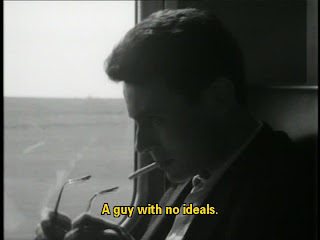


Le Petit Soldat is an interesting entry in Godard's ouevre. His second film, it is both a continuation and a departure from the themes explored in the kinetic cinematic celebration that is Breathless. Although the film is political in both form and content to use Comolli/Narboni's terms, there is little here that foreshadows the kinds of politicized films we are now considering in class. The blunt depiction of torture (which resulted in France banning the film until 1963) is provocative and disturbing, yet its effect intentionally undermined by the Bruno's voiceover. On the other hand, despite the film looking very similar to Breathless – i.e., jump cuts, shooting on location – the tone and focus shift squarely on the existential ennui of Bruno Forestier. If anything, Michel Poiccard's existential queries are the main thematic link between Breathless and Le Petit Soldat.


The setting of Geneva is also significant. As Douglas Morrey notes, Geneva is a city apart: too Swiss to be considered French, and too French to be considered Swiss. Forestier's voiceover describes the city being divided by two lakes. The film then can be a read in terms of a grey area between two defined regions, politically and metaphorically speaking. This ambiguity extends to the soundtrack, composed of dissonant piano music that refuses to resolve to either major or minor tonality – or any certain tonality at all.
Le Petit Soldat is essentially dealing with a world in which Bruno does not fit – he is asked to perform tasks to which ends he does not subscribe to and suffers the consequences for not completing these tasks – at the hands of both the French secret service and an Algerian terrorist group. We never learn why he deserted, although it isn't hard to venture a guess. As he describes himself in voiceover, he is a man without ideals, and is constantly questioning the nature of his existence. This in turn complicates his relationship to the world around him. The voiceover divulges his ambivalence toward the situation at hand – even when he being tortured by his Algerian captors he admits via voiceover that he doesn't even know why he is withholding the information being asked of him.
Forestier's hesitation to kill his target reminds me of Meursault in Albert Camus' The Stranger, which is set in French Algiers. The indifferent murder of the Arab man by Meursault is now replaced by the irrational indifference to the political/military aim represented by Bruno's assassination attempts. Perhaps this comparison is too forced though, as Bruno (and Godard) later dismisses Camus during his long speech at Veronika Dreyer's apartment, and in fact does end up assassinating his target with the voiceover suggesting that he has come to a personal awakening of sorts.
Anyone familiar with the work of director Claire Denis will recognize the name Bruno Forestier from Claire Denis's Beau Travail. Denis appropriated the character (also played by Michel Subor) as head of a small French Foreign Legion unit stationed in Djibouti. The force's presence and their barracks are an anachronistic vestige of France's imperial ambitions in the region. Denis' concerns with the outsider are of relevance here as the film resonates a similar kind of existential isolation. The film contains numerous allusions to Le Petit Soldat, which I will post soon as my Beau Travail DVD isn't working at the moment. It's important to note here that these allusions are not solely referential but constitute a thematic link between the two films: the lost ideal and the political, psychological and moral quandaries that accompany this state.
More stills soon!
Ian
Sunday, October 3, 2010
Godard and Jazz Improvisation
For my first blog post I would like to elaborate on a similarity I noted briefly in class between Godard's realization of Trufautt's treatment for Breathless, and the way in which jazz musicians use what is known as a “lead sheet” as a springboard for improvisation. For the benefit of those not acquainted with modern jazz music, I will use a well known and easily accessible piece as reference: Miles Davis' “So What,” from the classic album “Kind of Blue,” which was also recorded in 1959. (An interesting aside: before recording “Kind of Blue,” Davis performed the score for Louis Malle's 1958 film Ascenseur pour l'échafaud (Elevator To The Gallows), in which he was asked to improvise music to the mood of the sequences as they were screened for him.)
A “lead sheet” is a usually one or two page piece of sheet music which contains the basic skeletal elements of a given composition, especially a piece of “standard” repertoire. Often there is enough of a shared vernacular in repertoire that jazz musicians will not need to reference the music but as a rule, the lead sheet contains the basic musical information on which the musicians will base their performance. Typically a lead sheet contains only a treble clef while others include both treble and bass clefs, if the composition features a written bass part. Similar to classical theory's “figured bass” notation, jazz musicians refer to “chord symbols” to know for what duration of time any given chord center is lasts. The majority of the time, bassists and pianists refer to these chords symbols to improvise their support during the reading of the melody, and all players use this information as a starting point in their solos. Typically, jazz compositions cycle back to the beginning of the lead sheet once they've reached the end of the form (i.e., the end of the lead sheet); this way, any given soloist may improvise for as long as they please within this form and may finish with the next soloist ready to begin. A typical lead sheet or “chart” for a standard piece of repertoire might have as many as 10 chords, each functioning in their own to compose the chordal progression (or “changes”). It is important to note here that Davis' “So What” only has two chords for the entire 32-bar form: two 8-bar sections of D-minor, one 8-bar section of Eb-minor, and the one last 8-bar section of D-minor.
Below is a lead sheet for “So What,” along with a YouTube video which contains the original recording in its entirety. Note that the composition begins on the page when the (now famous) bass figure begins. There is a short piano/bass introduction on the recording which was written by Gil Evans, though it was not credited. The melody proper begins around 33 seconds and the improvisational sections begin at 1:32. Note the essential form of the composition during the improvisation sections is represented here by the tiny chart on the lower right side of the page. Below this, I have included stills from the lengthy hotel room scene in Breathless, along with the words from the treatment, as an analogue to the idea of the lead sheet. Indeed, any part of the treatment's translation into the film could be focused on in this way, but it is this sequence that most reminds me of the idea of jazz improvisation; of the translation of a simple idea into the sublime – even more so than the rhythm produced by the jump cuts during the films more kinetically edited moments.


What I find truly remarkable is the similarity here between the creative processes of jazz musicians like Miles Davis and the way in which Godard (as well as other filmmakers) bring to visual life the words from an original treatment. This is precisely what jazz musicians do-except the translation is to sound, as opposed to image.
As the 1960s unfold, Davis will revisit “So What” many times in live performances and the composition will undergo dramatic changes in treatment, tone, and unpredictability. Each progressive performance of the tune yields surprises. There is a similar feeling in Breathless – that if Godard used the same treatment as a starting point to make the film once again, what would result is a similar aggregation of chance, form, and rhythm, but a qualitatively different cinematic performance. Breathless was born of the circumstances of its production, just as Kind Of Blue was born both from loose concepts formed apriori as well as the moment of inception. In a sense Godard is like a jazz musician “riffing” on a kind of cinematic “lead sheet” throughout his early work: the Hollywood genre film. Using these cinematic templates as a starting point in films like Breathless, Pierrot Le Fou, Alphaville, and A Woman Is A Woman, Godard lets the process of discovery lead to the film's birth, and it's this art as process that he shares with contemporary modern jazz music. Is this not the same process of discovery that is felt when John Coltrane is heard at 3:25 on “So What”? There is a direct correlation in the process of translating the (in this case very scant) harmonic information on the page to the sublime level of Davis and company, and the translation of bare bones treatment in Breathless.
I will pursue this relation between movements in modern jazz and Godard's films – as well as art cinema in general – either in my next blog post, or as a presentation later on in the semester. Of particular interest is the “free jazz” movement marked by Ornette Coleman's mercurial arrival in New York in 1959. John Coltrane will also go on to play a pivotal role in this movement.
- Ian J
- Ian J
Subscribe to:
Posts (Atom)